Is Creality’s M1 & R1 Actually Worth Buying? (Ad)
 Reading Time: 3 minutes
 The Creality Filament Maker M1 & Shredder R1 is an unusual entry in the 3D printing ecosystem. Instead of printing directly, it allows users to create filament from pellets, color additives, and recycled print waste through a desktop workflow.
But after the initial hype, the real question is simple: Is it actually worth buying? The project is currently live on Indiegogo and ends at 9 AM PDT on May 15.
Recent hands-on testing from creators like BuildDanielBuild and Steve Makes Everything-style workflows helps clarify where the system works well, where it struggles, and who it is really designed for.
Workflow: Functional, But Not Plug-and-Play
Creator testing suggests the core workflow is functional, though still dependent on user setup and material preparation. BuildDanielBuild demonstrated recycling failed prints into usable filament while also experimenting with custom colors and material blending.
The M1 also introduces a more DIY-focused approach to filament production. Beyond color customization, users can experiment with additives and material combinations to create specialized filament with different finishes, modified properties, or even scented blends.
At the same time, testing consistently shows that this is not a fully automated appliance. Material preparation, extrusion monitoring, and color transitions still require user involvement. The system behaves more like a compact production tool than a simple consumer gadget.
Print Quality: Surprisingly Capable with the Right Mix
One major concern before launch was whether recycled filament would produce reliable prints.
So far, creator testing suggests the answer is yes, especially when recycled material is blended with virgin pellets. Under controlled conditions, output quality can approach standard PLA performance for:
- Supports and infill
- Functional parts
- Prototypes
SteveMakesEverything, a veteran engineer with decades of fabrication experience, also confirmed that controlled mixing produces the most stable results.
The broader takeaway is that recycled filament works best for practical printing scenarios where small inconsistencies are acceptable.
ROI: Highly Dependent on Usage Scale
This is where the M1 & R1 becomes more situational.
The strongest ROI appears in:
- Print farms
- High-frequency maker setups
- Workshops and prototyping environments
These users generate enough waste to gradually offset material costs over time.
For casual users, the financial return is less immediate. However, the system is not purely about saving money. For users interested in material experimentation, custom filament, or the DIY process itself, the value can extend beyond direct cost recovery.
Who Is It Actually For?
The M1 & R1 is best suited for users who:
- Print frequently
- Generate regular material waste
- Enjoy hands-on workflows
- Want more control over filament creation
It is less ideal for users expecting:
- Plug-and-play simplicity
- Instant ROI
- Minimal setup involvement
Final Verdict
The M1 & R1 does not reinvent filament production, but it does make desktop-scale recycling far more practical than many expected.
Its growing traction on Indiegogo, where the campaign has already surpassed $6M, suggests that users are increasingly interested in material efficiency, customization, and closed-loop workflows.
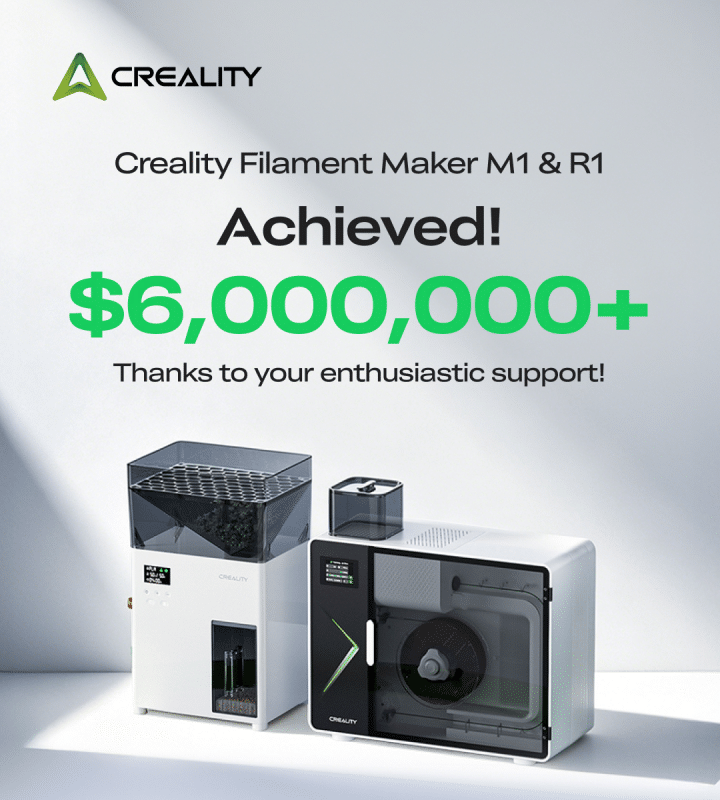
With the campaign ending at 9 AM PDT on May 15, the M1 & R1 sits in an interesting space: not essential for every user, but increasingly relevant for makers who want more control over how their filament is created and reused.
